


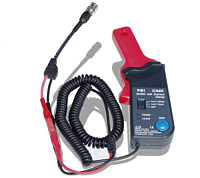
Current Probe, Low range, with Banana Plugs
This cost-effective low current probe is ideal for capturing waveforms from fuel pumps, injectors, relays, ignition and more. This probe can be used with just about any meter and lab scope capable of measuring DC voltage.
This low amp current probe can be used with multimeters and lab scopes and such as the Snap-on MODIS™, VANTAGE®, VERUS®, UEI scopes, Vetronix. In essence it can be used with any scope/meter that displays a voltage in digital or waveform format.
This amp probe features shielded wire, shielded housing, and 4mm shrouded banana plugs ensure an accurate signal.
Features
This current probe has the smallest nose (1" x 1/2") we have found.
Zero push button (not wheel).
Low battery indicator.
Lead terminates to banana plugs.
Low Current Probe Comparison
AES compared the Generic Low Amp Probe (AES# 07-60) to the Fluke 80i-110s Low Current Probe . The Fluke probe sells for over $400. Is it worth 4x the price?
Small Nose
The nose on this current probe measures 1-inch by 1/2-inch. As thick as your thumb and as wide as a US Quarter.

Connecting to a BNC connector
Use the AES# 08-88-m Flexible Adapter to connect the Generic Low Amp Probe (AES# 07-60) to scopes that use a BNC connector.
Fuel injector Current Waveform
Use the Generic Low Amp Probe (AES# 07-60) to measure injector cirucit current flow on sarurated, peak-and-hold and frequency modulated circuits. This example shows peak-and-hold injector current on a GM truck.

Primary Ignition Current Waveform
Use the Generic Low Amp Probe (AES# 07-60) to measure primary ignition current on Distributor, EI(DIS), and COP systems. Use this technique to spot bad coils, bad modules, simplify no-start diagnosis, etc.

Fuel Pump Current Waveform
Use the Generic Low Amp Probe (AES# 07-60) on fuel pump circuits to find bad commutators, brushes, worn pump mechanisms and more. A great way to predict pump failure before it happens and find the cause of certain intermittent problems. This technique applies to other electric motors as well such as blower motors, window motors, etc.

Scope voltage resolution limitations
Some scopes do not have very fine settings at low voltage levels, such as, 50mV per division. Since most low current probes have a 100mV/A output, this means that extremely low current waveforms such as from some injectors may be small and not very detailed. This is an issue with the scope, not the current probe. To overcome this, try using a "current multiplier". Coil a piece of wire 10 times. Place this coil in series with the circuit being tested. The measured current will now be ten times the actual current.
Do not connect to the "Amps" input
Current probes output a voltage in response to current flow so they must be connected to a voltage input, not your meters "Amps" input.
Simplify Calibration Settings
The Generic Low Amp Probe (AES# 07-60) has it's calibrations expressed in an unusual manner. They represent a very simple relationship though. 1mV/10mA can be expressed much simpler as 100mV/A and 1mV/100mA is more easily expressed as 10mV/A. Adding a piece of tape to the probe with these simpler labels is very helpful.
Parasitic Draw Testing
Due to the extremely low current levels involved with parasitic battery drain, the Generic Low Amp Probe (AES# 07-60) and other low current probes may not be the ideal tool for this application. We instead recommend a traditional series test with an amp meter. The AES Generic Low Amp Probe is ideal for solenoids (injectors, relays), primary ignition, motors (fuel pumps, power windows)and other applications.
Specifications
Size at end of jaw: 1" wide x 1/2" thick x 2-1/4" long
Conductor opening: 9mm
Test Lead: 6-feet long, terminates to shrouded Banana Plugs 4mm
Probe Housing: 7-3/4" x 2-1/2"
Accuracy: ranges from 1.5% to 2% under 20A and up to 8% over 20A.
Range: 10mA-60A
Frequency response: Up to 20KHz.
1-year warranty.